
Adjuvants and Surfactants for Better Weed Control
Herbicides play a vital role in protecting crops but simply
applying them may not always give the best results. Sometimes, additional
products called adjuvants are added to herbicide mixtures to improve their
performance. Understanding how adjuvants — especially surfactants — work can
help growers make more effective, safer, and economical herbicide applications. Adjuvants are chemical substances added to herbicide
formulations or spray tanks to improve how the herbicide works. They do not
have any direct pest control activity themselves, but they can:
- Improve effectiveness of herbicides
- Make it easier to mix with other products
- Change the way the spray behaves on plants
- Increase safety or reduce unintended effects
There are many
types of adjuvants available, each designed for a specific purpose. The various
types include defoamers, compatibility agents, drift control agents, buffers or
pH modifiers, extenders and stickers, wetting agents, spreader adjuvants,
safeners, emulsifiers, penetrants, thickeners. Many growers use the terms adjuvant and
surfactant interchangeably, but they are not the same. All surfactants are
adjuvants, but not all adjuvants are surfactants. Surfactants are a special
category of adjuvants designed to change how spray droplets interact with plant
surfaces. Surfactant’s main functions include:
- Improve
spreading of spray droplets
- Enhancing
wetting of leaves and plant surfaces
- Promoting better absorption of pesticides
In simple terms, surfactants help the herbicide
"stick” and spread more evenly across the treated surface, making it more
effective.
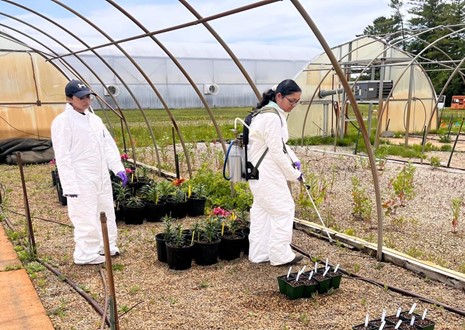
Debalina Saha
Associate Professor, Michigan State UniversityDebalina Saha is an Associate Professor of ornamental weed management in the Department of Horticulture at Michigan State University. She has an appointment in research, teaching, and Extension. Debalina provides statewide weed identification and management recommendations for ornamental plant production in greenhouses, nurseries, landscapes, and Christmas tree production. The primary goal of her research program is to improve upon current weed control practices and develop new effective methods of weed control using an integrated approach that involves both chemical and non-chemical strategies.